
How to keep track of gift ideas and what you've bought
Buying the same thing twice is the failure everyone worries about. The more expensive one is quieter: losing the single piece of information that would have made the gift right.
Here is what that looks like. A bedside charger, chosen carefully, the kind that takes a phone, a watch and a set of AirPods all at once. A hundred and forty pounds. What the buyer had forgotten was a remark from a few weeks earlier, that the watch was on its way out. By the time the charger arrived she had replaced it with a Garmin, which does not charge on it.
Nothing was bought twice. The information simply did not survive the gap between hearing it and needing it.
Most people don't have a system for this so much as three fragments: a note on your phone, a screenshot of something you saw, and a memory of something someone said. None of them is filed under the person's name, which is the only way you would ever find it again while standing in a shop thinking about your brother.
What follows works on paper, in a notes app, or in something built for it. The tool matters much less than the three habits.
1. Separate the idea from the purchase
One note cannot do two jobs. "Get Mum that book" and "bought Mum that book" need to look different from each other, or the list stops telling you anything.
Give every gift a state, and only three:
- Idea. You're considering it. Costs nothing, commits nothing.
- Bought. Money has left your account. This is the one that prevents duplicates.
- Given. It's been handed over, and now it becomes history worth keeping.
Move it the moment you buy. If you leave it until the weekend you won't do it, and that is the whole risk.
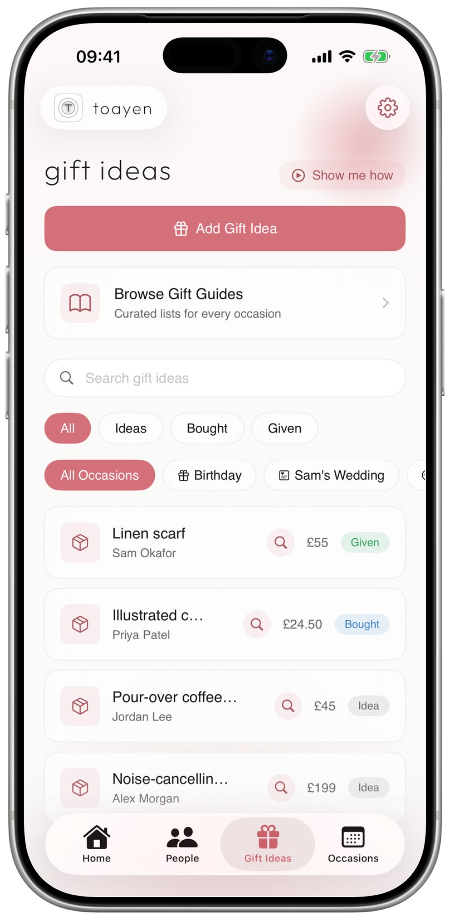
2. Capture ideas where you have them, not where you'll need them
The best ideas usually don't arrive while you're shopping. They arrive in the middle of something else, when someone mentions in passing that they've started running again, or that the thing they own keeps doing that.
The habit that works is to capture it in one tap, wherever you are, and not tidy it. A messy list you actually add to beats an organised one you don't. Two details make an idea usable months later:
- Who it's for. An orphaned idea is nearly useless by November.
- Why you thought of it. Links go dead and prices change. "Their kettle is dying" still works in November.
3. Keep the history
If you do keep a list, it probably doesn't survive into the next year. It should. A gift history answers questions nothing else can:
- What did I get them last year?
- What actually landed, and what politely didn't?
- Am I spending very differently on people I meant to treat the same?
That last one surprises people who buy for siblings or for several children. The gap only shows up once it's written down.
Where to start
Set aside twenty minutes. List everyone you buy for, and beside each name write what you got them last year and any idea you're already carrying.
You will remember less than you would like. That, on its own, is the argument for writing it down this year. After that, only two of the three habits take any effort, and the history builds itself out of them.
Toayen is this system, built. Somewhere to put the thing they mentioned in March, a state for every gift, and a history you can look back at. Free to download.